Where Should Musicians Promote Their Shows in 2026?
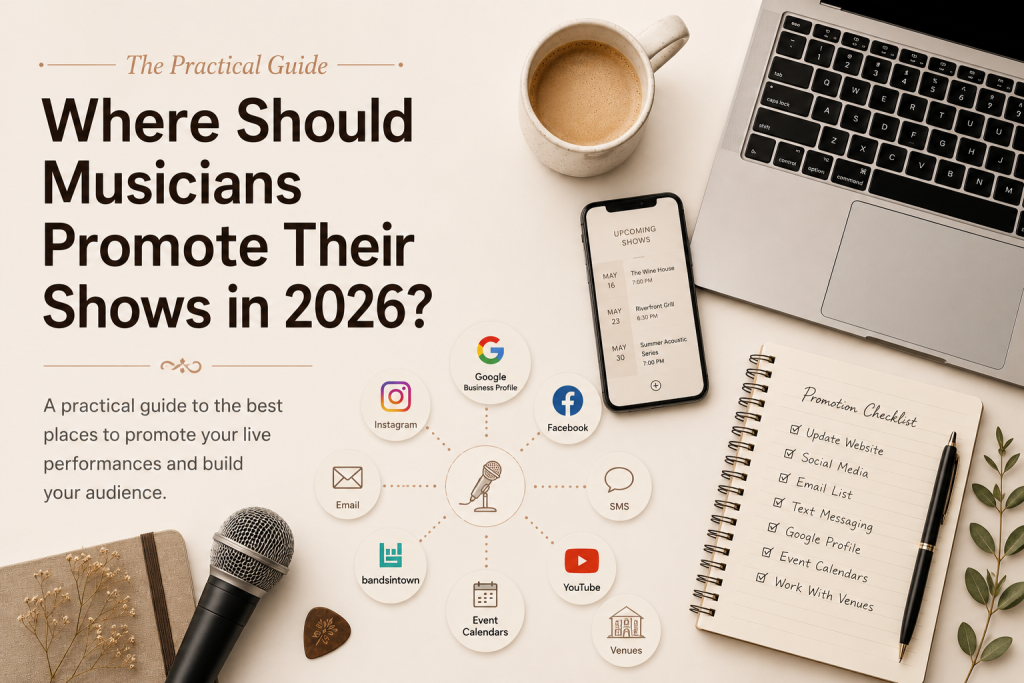
A Practical Guide from the Venue Side of the Stage
As a web developer and marketing consultant, I work with restaurants, venues, entertainers, galleries, and small businesses across Colorado and Virginia. A significant part of my work involves promoting live entertainment through websites, Google Business Profiles, event calendars, search engine optimization, social media, email marketing, SMS campaigns, and local media.
Unlike many articles written from the perspective of musicians or marketing agencies, I see things from the venue side of the business. My job isn’t simply to market a band — it’s to fill seats, drive reservations, and help businesses succeed.
One question comes up repeatedly:
Where should I promote my shows?
The answer has changed dramatically over the last decade.
Many musicians are still investing time in platforms that were incredibly valuable fifteen or twenty years ago while overlooking the channels today’s audiences actually use to discover live entertainment.
This guide isn’t based on theory. It’s based on years of managing entertainment marketing, coordinating performer schedules, promoting hundreds of live events, and seeing which marketing efforts consistently generate results.
If your goal is to build an audience — not just check another box on your marketing list — here’s where your time is best spent in 2026.
1. Your Website: Your Digital Home Base
If you have a website, it should always be the most current source of information about you and your music. Social media platforms come and go, algorithms change, and profiles get buried — but your website is the one place you completely control.
Include:
- Upcoming performances
- Booking information
- Biography
- Professional photos
- Videos
- Music
- Merchandise
- Email signup
- Social media links
- Press kit, if applicable
Every social media profile should point people back to your website — not the other way around.
Don’t have a website? It’s one of the best investments you can make in your career. Whether you’re a solo musician, band, entertainer, speaker, or performing artist, a professional website helps venues, event planners, and fans quickly learn who you are, find your schedule, and contact you for bookings.
Here are a few performer websites I’ve designed:
If you’d like help creating or updating your own website, feel free to contact me. I’d be happy to discuss your goals and build a site that showcases your work while making it easy for venues and audiences to connect with you.
2. Instagram
Instagram has become one of the primary ways people discover musicians and entertainers.
Use it to share:
- Feed posts
- Stories
- Reels
- Performance clips
- Behind-the-scenes content
- Upcoming show announcements
Short, authentic videos often outperform polished promotional graphics. Consistency matters far more than perfection.
3. Facebook
Despite predictions of its demise, Facebook remains one of the most effective platforms for promoting local live entertainment.
Use it to:
- Create Facebook Events
- Share venue posts
- Invite followers
- Post reminders
- Upload performance videos
- Share behind-the-scenes photos
Many audiences—especially those attending restaurants, wineries, breweries, festivals, and community events—still rely heavily on Facebook to discover local entertainment.
4. Bandsintown
Bandsintown remains one of the best concert discovery platforms available.
Fans can:
- Follow artists
- Receive automatic concert alerts
- Purchase tickets
- Discover nearby performances
If you’re playing regularly, this should be part of your marketing toolkit.
5. Songkick
Songkick works similarly to Bandsintown and integrates with several music services.
While it tends to favor touring acts, local musicians can still benefit from maintaining an active profile.
6. Google Business Profile
If you perform professionally under a band or artist name, consider creating a Google Business Profile.
Benefits include:
- Google Search visibility
- Google Maps visibility
- Photos
- Posts
- Reviews
- Contact information
- Website links
Many musicians overlook this opportunity, yet it’s one of the easiest ways to improve your local visibility.
7. Search Engine Optimization (SEO)
Having a website is only part of the equation. Search engines need to understand your content before they can recommend it.
Make sure your website includes:
- Descriptive page titles
- Meta descriptions
- Fast-loading pages
- Mobile-friendly design
- Optimized images
- Internal links
- Local SEO
- Event Schema (JSON-LD) for every performance
Structured Event Schema tells Google exactly what your performance is instead of forcing it to guess.
Proper event markup should include:
- Event name
- Date and time
- Venue
- Address
- Performer
- Ticket or reservation links
- Featured image
- Description
It’s one of the most overlooked aspects of entertainment marketing and can significantly improve how your performances appear in search results.
8. Build an Email List
Social media is rented space.
Your email list belongs to you.
Every performance is an opportunity to invite fans to join your mailing list.
Use it to announce:
- Upcoming performances
- New music
- Merchandise
- Holiday shows
- Ticket sales
- Special events
Even a modest mailing list can become one of your most valuable marketing assets over time.
9. Add Text Messaging (SMS)
Text messaging consistently delivers some of the highest engagement rates available.
It’s perfect for:
- Tonight’s performance
- Last-minute bookings
- Schedule changes
- New music releases
- Merchandise announcements
If you’re looking for a platform, I recommend SlickText. It’s the system I use for many of my own clients because it’s easy to manage and works well for venues, restaurants, entertainers, and small businesses.
Affiliate Disclosure: I use and recommend SlickText. If you sign up through this link, I may receive a commission at no additional cost to you.
10. Work With Your Venues
One of the biggest mistakes performers make is assuming the venue will handle all the promotion.
Help them help you by providing:
- Current publicity photos
- A short biography
- Your website
- Social media links
- Promotional graphics
- Logos (if applicable)
- Updated descriptions
Then actively share the venue’s promotional posts with your own audience.
11. Local Event Calendars
Many communities maintain event calendars that rank well in Google search results.
Look for:
- Tourism organizations
- Chambers of Commerce
- Community calendars
- Local newspapers
- Arts organizations
- Downtown associations
Many accept free submissions, and they’re often free.
12. Community Groups
Don’t overlook local audiences.
Share your performances in:
- Community Facebook Groups
- Neighborhood groups
- Reddit communities
- Nextdoor
- Local music groups
Always follow each group’s posting rules.
13. YouTube
You don’t need polished music videos.
Simple content works.
Ideas include:
- Performance clips
- YouTube Shorts
- Rehearsals
- Song previews
- Behind-the-scenes videos
YouTube also improves your visibility in Google searches.
14. TikTok
TikTok isn’t necessary for every performer, but it can be incredibly effective for musicians looking to reach new audiences.
Authenticity generally performs better than highly produced content.
15. Streaming Platforms
Spotify, Apple Music, Amazon Music, and YouTube Music aren’t event calendars—but they’re still part of your marketing ecosystem.
Keep your artist profiles current and make it easy for fans to discover your music after seeing you perform live.
16. Other Music Platforms
There are many online platforms that can help musicians establish a web presence, distribute music, or promote upcoming performances. Depending on your goals, you may find value in maintaining profiles on services such as ReverbNation, Bandcamp, SoundCloud, Sonicbids, and similar music-focused platforms.
These services can be especially helpful for artists who don’t yet have a dedicated website. They provide an affordable way to share music, post photos, list upcoming performances, and give fans a place to learn more about you.
Just remember that these platforms are only one piece of your overall marketing strategy.
Whenever possible, make your own website the hub of your online presence. Your website is the one place you completely control, and every profile you maintain on other platforms should point visitors back to it. That way, regardless of which service a fan discovers you on, they’ll always have a reliable place to find your latest schedule, booking information, and contact details.
If you use platforms like ReverbNation, Bandcamp, or SoundCloud, keep them current, but don’t rely on any single third-party service as your primary online presence.
Quick Promotion Checklist
☐ Update your website
☐ Add your next performance
☐ Verify Event Schema (JSON-LD)
☐ Update your Google Business Profile
☐ Create an Instagram post
☐ Share a Reel or Story
☐ Create a Facebook Event
☐ Share the venue’s posts
☐ Update Bandsintown
☐ Update Songkick
☐ Send an email newsletter
☐ Send a text message
☐ Submit to local event calendars
☐ Share in community groups
☐ Upload a YouTube Short
Final Thoughts
You don’t need to be everywhere.
You need to be where your audience is.
The musicians who consistently draw crowds aren’t necessarily the ones playing the most shows—they’re the ones who make it easy for fans to discover them, remember them, and return again and again.
A thoughtful, consistent marketing strategy—built around assets you control and platforms your audience actually uses—will almost always outperform chasing the latest trend or relying on a single service to do the work for you.
Let's Build Your Audience